


Gifting has never been easier
Perfect if you're short on time or are unable to deliver your gift yourself. Enter your message and select when to send it.


How to use flower frogs, kenzans, and pin holders to create intentional floral compositions

From floral shops to home arrangers, there's one tool you'll find that transforms stems into sculpture: the flower frog. These unassuming pieces have anchored arrangements for over a century, yet their purpose remains a mystery to many who admire the compositions they support.
A flower frog is a weighted base with openings, holes, or pins designed to hold flower stems in place at the bottom of a vase or bowl. The name itself speaks to function rather than form—these tools help stems "sit" precisely where you want them, much like a frog rests motionless until the perfect moment to move.
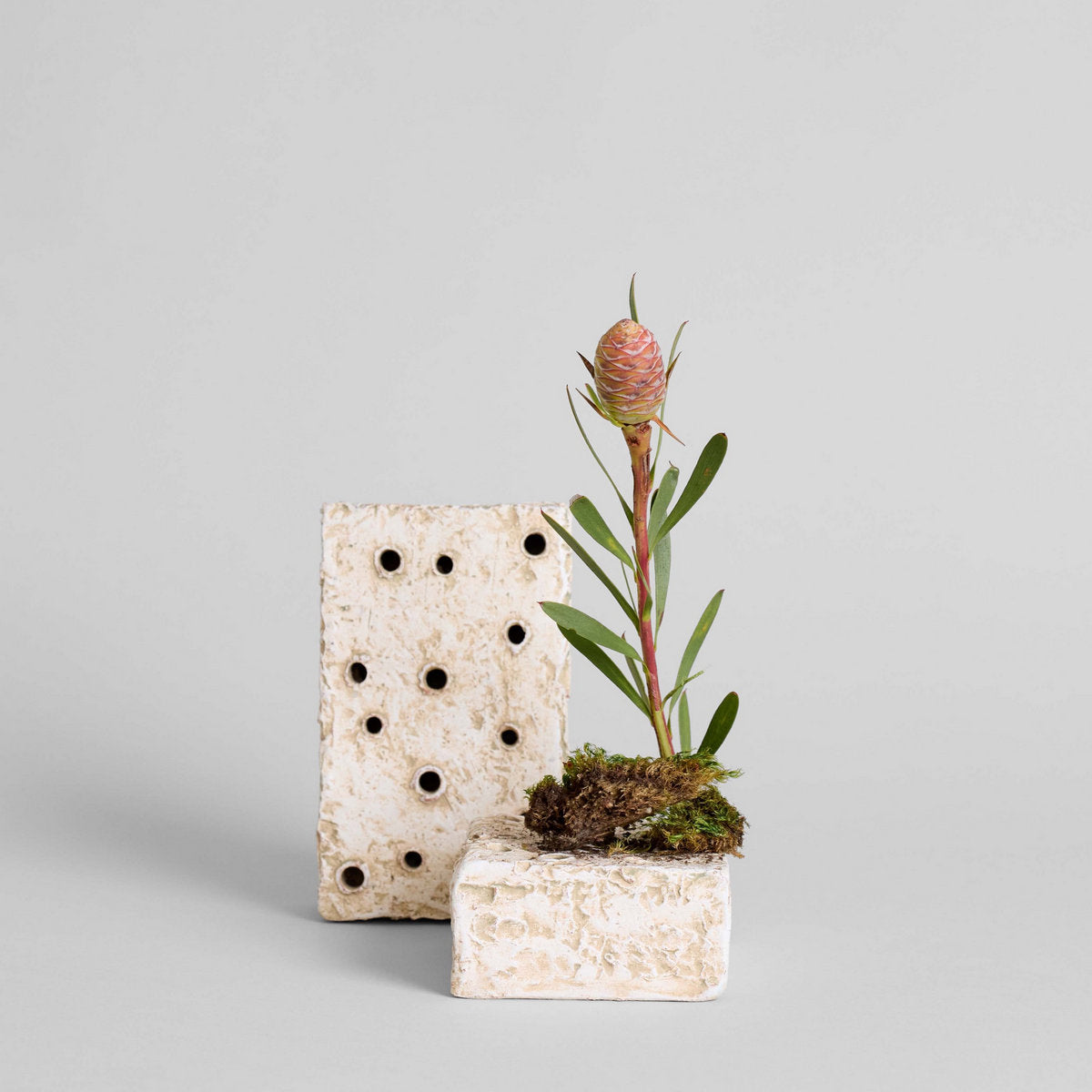
The most recognized type today is the kenzan, or pin holder, which emerged from Japanese ikebana practice. Rows of sharp brass or steel needles rise from a heavy metal base, ready to pierce and support stems at exact angles. But flower frogs take many forms: glass for a seamless look, ceramic blocks with geometric openings, brass pieces built for durability, and handcrafted stone frogs with carefully drilled chambers.
Before the invention of floral foam in the 1950s, flower frogs were the primary tool for creating structured arrangements. Today, as we move away from single-use plastics and synthetic materials, these enduring tools offer a sustainable alternative that can serve generations of arrangers.

TERRACOTTA FROG VASE


STACKING STONE FROG


The Western flower frog emerged during the Victorian era, when elaborate floral displays demanded invisible support systems. American glassmakers created intricate pressed-glass frogs that doubled as decorative elements when empty. Ceramic versions followed, often glazed in colors that complemented period pottery as well as brass flower frogs.
Meanwhile, in Japan, the kenzan evolved as an essential tool for ikebana—the disciplined art of Japanese flower arranging. Unlike Western arrangements that often celebrate abundance, ikebana emphasizes space, line, and the relationship between elements. The kenzan's precise pins allow arrangers to position each stem with intention, creating compositions that speak through restraint rather than excess.
Our collection of Niwaki kenzan flower frogs, crafted in Japan with brass pins strong enough for woody branches yet gentle on soft stems, represents this centuries-old tradition. Available in sets or individually, each piece carries the weight needed to anchor meaningful arrangements.


Some flower frogs are beautiful enough to stand on their own. Our stone and ceramic frogs work as sculptural objects in their own right—place them directly on a table, shelf, or windowsill and arrange stems without any vessel at all. The frog becomes part of the composition rather than hidden support.
When you do pair a flower frog with a vessel, the choice shapes the entire arrangement. Wide, shallow bowls work beautifully with pin holders for ikebana-style compositions. Our Beach Stone Ikebana Vase, hand-carved from New England river stones, comes with its own stainless steel pin frog—the 2-inch opening creates an intimate stage for minimalist arrangements.
For ceramic or brass flower frogs with holes, consider vintage-inspired vessels or modern recycled glass hurricanes that allow the frog's pattern to remain visible, adding another layer of visual interest.

Place your flower frog in the center of your chosen vessel. For pin holders, ensure the base sits flat and stable. Add water to cover the pins by at least an inch—this keeps stems hydrated while maintaining the structural integrity of your arrangement.
For frogs with holes rather than pins, you might need to anchor them with floral putty if they're lightweight. Our brass frogs with multiple opening options stay put thanks to their substantial weight, eliminating the need for adhesives.

Start with your structural elements—branches or sturdy stems that establish the arrangement's height and movement. For pin holders, cut stems at a sharp angle and press firmly onto the pins. The needles should penetrate about half an inch into the stem, creating a secure anchor while allowing water uptake.
With hole-style frogs, thread stems through openings that match their diameter. The Ceramic Frog Block offers various hole sizes, letting you combine thick branches with delicate blooms in a single arrangement.
Build your composition thoughtfully. In ikebana practice, this means considering three main elements: shin (heaven), soe (human), and hikae (earth). Even in Western-style arrangements, this principle of varying heights and angles creates dynamic tension and visual flow.
Layer materials of different textures—pair the architectural lines of dried natural bunny branches with the softness of faux flowers. Use your frog to create radical angles impossible with traditional vase arranging. Position stems horizontally across the pins to create floating effects, or cluster multiple small stems through a single hole for density contrast.
For those drawn to Japanese aesthetics, explore our complete ikebana collection, including specialized ikebana scissors designed to cut stems cleanly without crushing fibers, ensuring longer vase life.
After each use, remove plant material carefully to avoid bending pins or chipping ceramic. Clean kenzan pins with a soft brush—an old toothbrush works perfectly—to remove any plant residue. For brass frogs that develop patina, decide whether you prefer the aged look or want to maintain shine. We lean toward letting brass age naturally, but if you prefer brilliance, combine lemon juice with baking soda to create a gentle polishing paste.
Store flower frogs carefully. Wrap pin holders in cloth to protect the needles. Stack ceramic frogs with tissue between them. These tools, treated with care, become heirlooms—each arrangement adding to their story.
Today’s arrangers use flower frogs in ways their inventors never imagined. TOur Beach Stone Ikebana Vase doubles as a minimalist sculpture when not holding stems. Small kenzan can serve as stands for taper candles, their pins gripping the wax securely. Brass frogs also function as propagation stations, with openings perfectly sized for rooting cuttings in water.
In professional settings, flower frogs offer a sustainable alternative to foam. Event designers value their reusability, while home arrangers appreciate their versatility—one frog can support countless arrangements, unlike single-use mechanics.

Choosing a flower frog depends on your arranging style and preferred vessels. For those drawn to Japanese simplicity, a kenzan floral frog set offers a range of sizes for different scales of work. Round versions suit most vessels, while rectangular frogs lend themselves to linear compositions.
Those who prefer organic materials may gravitate toward our Stone Stacking Floral Frog, hand-cut and fused by artisans in Honduras. With holes drilled on both ends, flipping the stone reveals entirely different arrangement possibilities—two tools in one.
For versatility, brass frogs with multiple opening styles accommodate everything from single specimen displays to complex arrangements. Their substantial weight keeps them stable in any vessel.

Working with flower frogs requires a different process than quick vase arrangements. Each stem placement is deliberate. The tool demands you slow down, consider angles, and appreciate individual stems rather than massing flowers together.
This measured pace connects us to earlier eras when flower arranging was meditation, not decoration. When each bloom was precious, selected rather than bundled. The flower frog enforces this mindfulness—you cannot rush the pins, cannot force stems through too-small holes.
In our world of constant motion, perhaps this is the flower frog's greatest gift: permission to pause. To hold a stem, consider its curve, and find its perfect position. To build something beautiful slowly, with intention, knowing the foundation will hold.
Browse our complete collection of vases and accessories to find vessels that pair beautifully with flower frogs. For inspiration on matching blooms to vessels, explore our guide to pairing flowers with the right containers. And for those ready to explore the meditative practice of ikebana, our curated selection of Japanese floral tools provides everything needed to begin this journey.




Your Shopping Cart is Empty
Browse our latest collection or check your saved favorites to add more items to your cart.




Manage your profile, track your orders, and enjoy a seamless shopping journey with us.