


Gifting has never been easier
Perfect if you're short on time or are unable to deliver your gift yourself. Enter your message and select when to send it.


An exploration of materials that bring ease through texture, weight, and use

We’re at our best when there's a familiarity and calmness to our surroundings. Calm doesn't come from adding more things. It comes from choosing well—materials that feel familiar, surfaces that wear in rather than out, and objects that support daily life without visual noise.
When a home is decorated with natural materials, each room begins to feel more considered and easier to be in. There's a rhythm that develops when what surrounds you carries integrity across spaces. Wood that shows its grain honestly. Linen that softens with each wash. Clay that holds its form without pretense. These materials offer texture and warmth in ways that synthetic counterparts simply can't replicate.
We look to wood, linen, clay, botanicals, plant-based ingredients, and other natural materials that have been used for generations and remain relevant today. Their longevity isn't accidental. These are materials that respond well to daily handling, that develop character rather than show wear, and that connect us to making traditions that value craft over mass production. There's comfort in reaching for something that feels like it could have existed decades ago, and will still feel right decades from now.
Below, a room-by-room look at how natural materials bring clarity and ease into the home.

The kitchen benefits most from simplicity. It's where function matters most, where every object is tested daily. Wooden utensils, terracotta crocks and pitchers, and hand-finished tools bring warmth to everyday tasks without crowding the space. Their materials are honest and familiar.
These aren't objects chosen for novelty—they're chosen because they perform their intended purpose beautifully and become more themselves with use. There's a weight and heft to an end-grain larch cutting board that composite materials can't replicate. The kiln-dried wood feels dense and stable under the knife. The surface is forgiving to blade edges while remaining durable enough to handle daily prep work without warping or splitting.
When tools are chosen carefully, counters stay clearer, and the room feels easier to move through, even on busy days. Visual clutter often begins with accumulation—too many gadgets, too many options. When each tool is selected for quality and genuine usefulness, the need for multiples fades. You reach for the same knife, the same bowl, and the same cutting board, because they're exactly right. This creates a kitchen where cooking feels more intuitive with less effort. The space itself seems to breathe.


Workspaces often lean toward function alone. Efficiency becomes the only metric, and the result can feel austere or disconnected. Introducing small, organic pieces—like glass paperweights with delicately preserved botanicals—adds balance without interruption.
Their weight keeps papers in place while their sculptural forms soften the hard lines of a desk. They also look just as alluring when displayed on a shelf or tablescape. These objects do real work—they anchor, they organize—but they also provide visual respite. When your eyes need a break from screens, they land on something that references the natural world, something that doesn't demand anything but offers a momentary grounding. A small plant—perhaps a kokedama on a shelf or a compact potted bonsai—can serve a similar purpose. Wooden desk accessories—like letter trays and organizers from makers such as Fritz Hansen—bring warmth to a workspace while serving a genuine purpose.
The desk becomes less of a purely transactional space and more of a place you're willing to spend considered time. Natural forms introduce irregularity in an environment often dominated by right angles and uniform surfaces. This small disruption—this reminder that not everything needs to be engineered—can shift how focused and settled you feel during long working hours.


Hemp sheets, yak and cashmere down throws, and decorative pillows bring softness to the bedroom. The fabric breathes easily, moves naturally, and becomes more comfortable with use. Hemp, in particular, is remarkably suited to bedding—durable, naturally antimicrobial, and softening beautifully over time without pilling or thinning. Yak down offers warmth without weight, a quality difficult to achieve with synthetic fills. Cashmere imparts an unmistakable softness—fine fibers that feel almost weightless yet provide substantial warmth, a textile that has signified quiet luxury for centuries.
Visually, linen keeps the room light and uncluttered. Its texture adds depth without pattern or shine, helping create a space that feels composed and welcoming at the end of the day. There's an ease to linen that comes from its natural variation—slight slubs in the weave, subtle variations in color. It doesn't try to be perfect, and that imperfection is exactly what makes it restful to look at.
The bedroom should feel like a retreat, not another space demanding decisions. Natural textiles support this by being inherently calming. They don't reflect light harshly. They don't trap heat. They age gracefully, which means you're not constantly evaluating whether they still look "good enough." Instead, they become better—softer, more familiar, more yours.


Living rooms benefit from elements that add form—some that evolve with care, others that remain consistent. The choice depends on what the space needs and what you're drawn to.
For those who find purpose in tending living things, kokedama and bonsai offer a different kind of presence. A kokedama—a moss ball holding soil and roots with a live plant—brings sculptural softness to a shelf or side table. A low-maintenance addition, kokedama thrives with just a bit of care. Bonsai operates similarly: regular but not demanding. Both trace back to Japanese tradition—kokedama emerging from the broader art of nearai, where plants are displayed without containers, and bonsai from centuries of cultivating miniature trees that capture the essence of their full-scale counterparts. These aren't trends but enduring forms that have remained relevant because they distill care into something tangible and contained. Tending to these plants is grounding, a way of marking time through something other than a calendar. Both forms bring the irregularity of living growth indoors. They occupy space differently than cut arrangements, growing and changing over time rather than offering a single moment of bloom.
The bedroom should feel like a retreat, not another space demanding decisions. Natural textiles support this by being inherently calming. They don't reflect light harshly. They don't trap heat. They age gracefully, which means you're not constantly evaluating whether they still look "good enough." Instead, they become better—softer, more familiar, more yours.

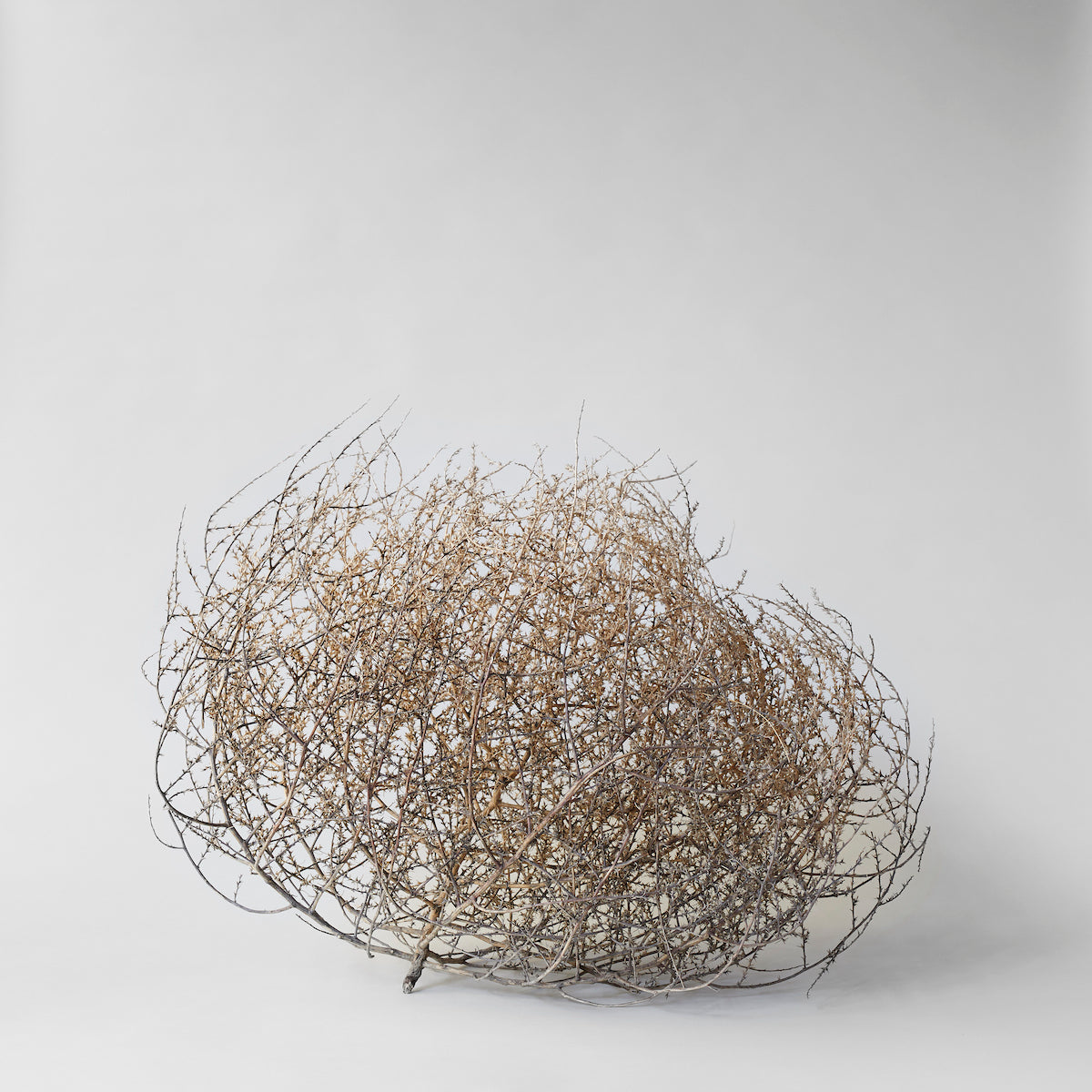
For spaces where consistency matters more than change, or where care routines don't fit easily into daily life, dried branches, preserved stems, and well-crafted faux botanicals introduce natural silhouettes that work year-round. These pieces don't ask for anything beyond their initial placement (just some light upkeep), yet they still reference the organic world.
Arranged loosely in a ceramic vase or placed on a shelf, botanicals—whether living or preserved—connect interior spaces to the natural world, especially during winter months when outdoor greenery retreats. Living plants bring the subtle changes of growth and seasonal adjustment. Both approaches layer the room without making it feel fussy.
There's a difference between arrangements that look constructed and those that look gathered. The best botanicals—dried, faux, or living—have the irregularity of real growth: slight bends, varied thicknesses, organic branching patterns. They become part of the room's architecture rather than decorative add-ons, marking time and offering visual interest in ways that feel intentional but never forced.


In the bathroom, materials matter as much as function. This is often the first and last place you engage with each day. Small-batch soaps made with plant-based oils and botanical ingredients offer a different experience than mass-produced formulas. Their lather feels gentle, their scents come from essential oils rather than synthetics, and their finishes reflect the care that goes into making them. Natural oils—sea buckthorn, rosehip, sunflower seed—cleanse without stripping the skin, leaving it comfortable rather than tight. Commercial soaps often rely on harsh detergents that foam impressively but disrupt the skin's natural moisture barrier. Plant-based formulas work with your skin, not against it. The difference is noticeable within days: less dryness, less irritation, a more balanced feeling.
Subtle scent profiles—herbal, citrus, or softly floral—engage the senses without lingering too heavily in the space. Essential oils provide fragrance that fades gracefully rather than competing with other scents in your routine. These are scents that enhance the moment without dominating the entire morning or evening.
Paired with ceramic or stone dishes, these soaps become part of the room rather than something hidden away. A handmade soap resting on a simple ceramic tray or a smooth stone dish becomes an element of the space, not clutter to be concealed. The object and its vessel work together, both chosen for materials that improve with exposure to water and air rather than degrade.

Beyond soap, the bathroom benefits from textiles and objects chosen with the same attention. Linen hand towels—like those from Libeco—absorb quickly and dry faster than cotton, becoming softer with each wash. Left folded on a rail or hung from a simple hook, they contribute visual warmth through their natural color variation and subtle weave.
Candles introduce measured light and scent. The flicker softens hard surfaces and creates a boundary between the activity of the day and the stillness of evening routines. Unscented candles offer light without competing with soap or other fragrances. Lightly scented options can layer with other elements if chosen carefully.
Small vessels hold cotton rounds, swabs, or other daily necessities. A stone tray corrals bottles and jars. A wooden stool provides a place to set a towel or rest a moment. These are all functional pieces, chosen from materials that work in humid environments and bring warmth to a room often dominated by cool, hard surfaces.
The bathroom, more than most rooms, reveals the difference between objects chosen quickly and those chosen with care. What's touched daily, what's seen first thing each morning—these details accumulate into the feeling of a space. When materials are honest and well-made, the room supports the practices it holds rather than simply containing them.


Creating a calm environment at home doesn't require a full reset. It begins with paying attention to what you touch every day. These small, repeated interactions shape how we move through our days more than we realize.
Natural materials bring continuity across rooms. They age well, feel familiar, and shape spaces that feel easier to move through and easier to return to. There's a coherence that develops when materials echo each other from room to room—not in an overly coordinated way, but in a shared sensibility. Wood in the kitchen, wood on the desk, wood framing the mirror. Linen on the bed, linen hanging on the back of a chair. These repetitions create visual and tactile threads that tie a home together without formula.
When each room is considered on its own terms, the home as a whole begins to feel more balanced. This means resisting the urge to apply the same solution everywhere and instead asking what each space actually needs. The kitchen needs durability and warmth. The bedroom needs softness and calm. The office needs focus and grounding. Natural materials offer enough variety to meet these different requirements while maintaining an underlying integrity.
We create and curate objects made from materials chosen for their honesty and longevity—pieces meant to be used, touched, and lived with over time. This is the opposite of decorating for a look that might be replaced next season. It's choosing pieces that will become more essential, more comfortable, more right as years pass. It's understanding that true simplicity isn't about having less for its own sake, but about having exactly what serves you.

Your Shopping Cart is Empty
Browse our latest collection or check your saved favorites to add more items to your cart.




Manage your profile, track your orders, and enjoy a seamless shopping journey with us.